
300B / 300BM+ Data Sheet
Description
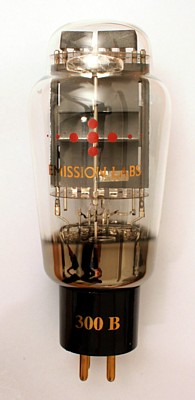
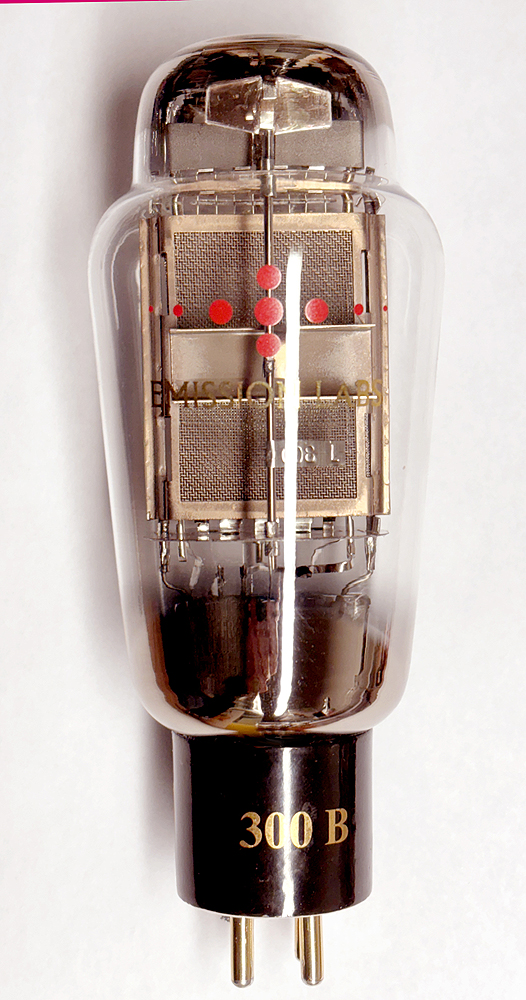
300B Solid Plate |
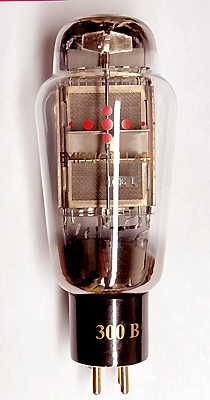
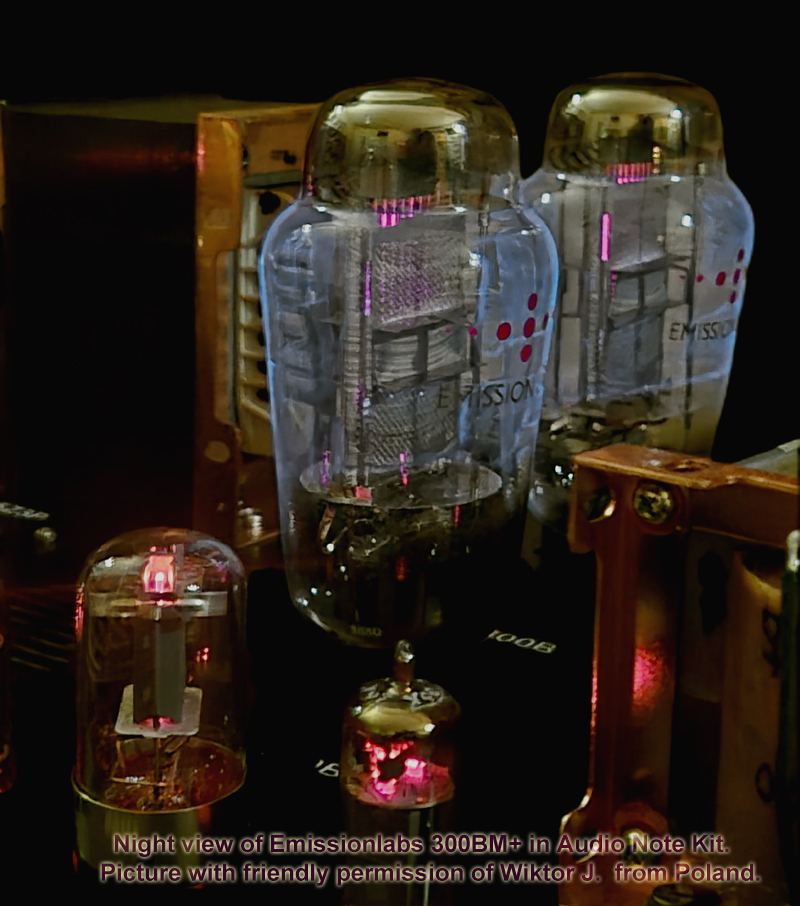
300BM+ Mesh Plate |
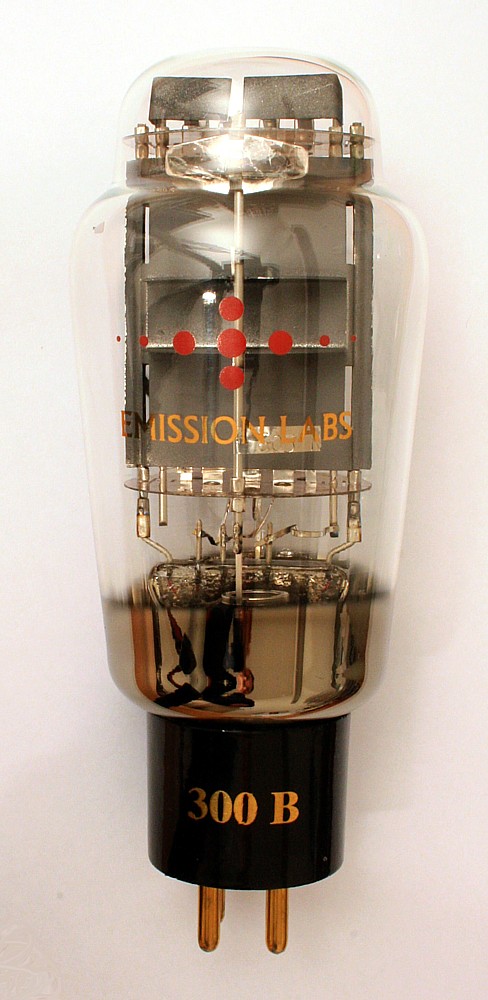
This tube is a direct replacement for the Western Electric E300B as build until 1988. Glass height however is 15mm longer. Diameter is the same. |
Product Release February 2026 This tube can be used in all 300B power amplifiers. For pre amplifiers and head phone we recommend Solid plate. |
Guarantee program for first owner
At EML we have the normal guarantee. In addition to that, the first owner can register the tube within 4 weeks after receival, at the Emission Labs website, to participate in the 5 years guarantee program.
Register here for the 5years guarantee
Features
-
Gold Plated Grid (Note)
-
 Soft rubber suspended tube base
 -
Hard metal Construction (Note)
-
Extra large getters
-
Hand blown Glass bulb
-
Anti-microphonic Anode- and grid suspension
-
These tubes are shipped in a high quality dual box
-
Tube printing with 24k gold, and red color burned into the glass
-
Gold Plated pins, black ceramic socket, with white bottom
Sound Character of the EML 300B
It is probably the most asked question, and for this we refer to the genuine 300B, as made until 1988 by Western Electric itself, in the Hawthorne plant, in USA.
The 300B tube has less interaction with the speaker system, as smaller tubes like the 45 have. This makes the overall sound less dependant on the speakers, and more dependant on the tubes itself. We see 300B often used with medium efficiency loudspeakers. Meaning, the tube often needs to work medium hard, which is indeed what the 300B is designed for. There are some more requirements too.
With low to medium efficiency speakers, relatively high output power at low distortion is required. Another requirement is, distortion should increase as little as possible, during the aging process. This requirement is often overseen, because tube owners have a high lifetime expectation anyway, even though this tube is loaded quite hard by some amplifiers. So the 300B has to build with as much as possible reserve emission. This is just what we are doing at EML. Low distortion needs emission reserve.
The low distortion of EML 300B, can optically be seen from the tube curves. This is demonstrated by the equal distance between each curve, specially where they are close to the horizontal axis, in the high voltage range. The more uniform at this difficult region, the higher the emission of the tube probably is. Compare this with other brands, and you will see the difference. We achieve this by our unique filament and grid construction, featuring a real, physical filament Cathode tap, positioned outside of the grid, but inside the glass bulb. We use gold plated grids, and a very long life cathode coating. The gold plated grid ensures constant tube data over the entire lifetime.
Sound Character of the EML 300B Mesh
Mesh tubes have a sound of it's own.
Click here for a detailed, general description.
.EML 300B Filament Ratings |
|
Filament Voltage |
= 5 Volt (AC or DC) |
| Electronic heater modules: | Only voltage source |
Tolerance on filament voltage |
-4... +5% |
Filament Current |
~ 1.3 Ampere |
| Maximum Time on Stand By (Heater voltage only) |
2 hours |
EML-300B Factory Test conditions |
|
| Anode Voltage | |
| Anode Current | |
EML-300B Factory Test Result at 300V, 60mA |
|
| Grid voltage ( AC heated) | |
| Grid voltage ( DC heated) | |
| Transconductance | |
| Note: these are average values, variation is appr 5% for random tubes. Any other current will also give another transconductance | |
EML-300B incoming inspection. Tested at 300V, 60mAMultiply -Grid Voltage with transconduction |
|
| New tube. AC heated. | |
| New tube. DC heated. | |
EML 300B Capacitance |
|
| Grid to Plate | 15pF |
| Grid to Filament | 8.5pF |
| Anode to Filament | 4pF |
EML 300B Factory Test conditions |
|
| Anode Voltage | 300V |
| Anode Dissipation | 17Watt |
| Anode Current | 56mA |
| Anode Impedance | 700 Ohm |
| Amplification Factor | 3,9 |
| Transconductance | 5.6 mA/V |
| Control Grid Voltage | matched |
| Transconductance | matched |
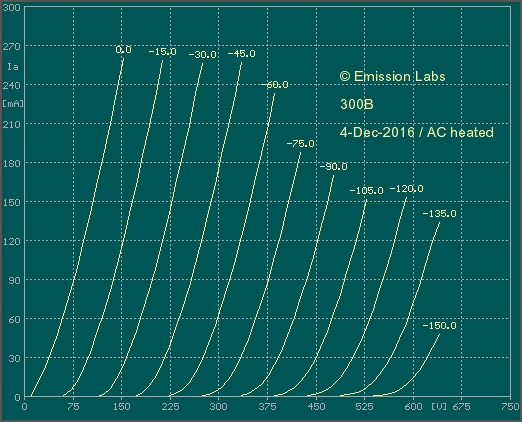
EML 300B tube curves. See Note 3
300B Anode Curves Print Version (full size pdf)
Some recommended Lundahl transformers |
|||||
Primary |
Secondary |
Auto Bias Cathode resistor |
Anode Current |
Anode Voltage to ground |
|
LL1623-090mA 11Hz @1.5dB |
3000Ω |
Alt.B = 4Ω Alt.C = 8Ω Alt.D = 16Ω |
750 Ohms |
80mA |
435V |
| Alternative: Use transformer Impedance Boards for LL1623 by JACMUSIC. EE16 switches between 4 and 8Ohms at 3k. EE18 switches between 8 and 16Ohms at 3k. |
|||||
LL1664-080mA |
3000Ω |
8Ω |
750 Ohms |
80mA |
435V |
| Complete list of recommendations here | |||||
EML 300B Mechanical Data |
|
|
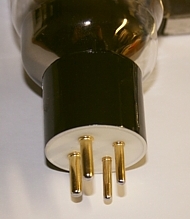
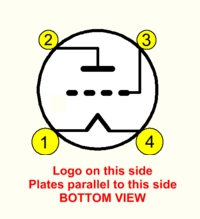
Size including Socket 148 x 65 mm Pin 1: Heater1 Weight of one tube: Shipment weight for pair in gift box: |


Notes
- Hard-metals can be used in electron tubes, though these are more difficult to use, and more costly than classic nickel. Hard metal Anodes have a more precise Anode distance, and do not change shape when heated, or at mechanical shock. This ensures reproducible tube parameters, and long term stability. Wolfram grids allow the most precise grid wire distance, because wolfram is an extreme hard metal. Best grid geometry ensures uniformity and linearity of the tube curves.
- Individual Test data, such as: Matching Data, Grid Current, Vacuum, Filament Current, etc., are on the Certificate that is on the outside of the tube box. Each tube is numbered from the inside, with a metal Tag
- Average Plate Characteristics are made with the Sofia Digital Curve tracer.
- We are recommending the same values as Western Electric in their 1950 Data sheet.
- The Western Electric 1950 Data sheet. says 36 Watt maximum dissipation. Later data sheets say 40 Watt. Though 40 Watt is possible, this is a peak value only, and no normal working point. When you intent to get the maximum out of a 300B, and operate this tube at the limits of safe operation, it is a better idea to use the 300B-XLS in such a case.
- Some of our competitors claims to be the only one with a Center Tapped filament, but at EML we build since many years all tubes Cathode Tapped, not just this tube.
- Do not experiment with lower filament voltage, to expect better lifetime. We already specify filament voltage for the best lifetime.
- Gold Plated grids have a few advantages, such as increased bias stability, some protection against accidental overload, and better linearity of tube curves.
- The curves for the 300B are plotted, with AC heating. This is in accordance with the historical WE data sheet.