

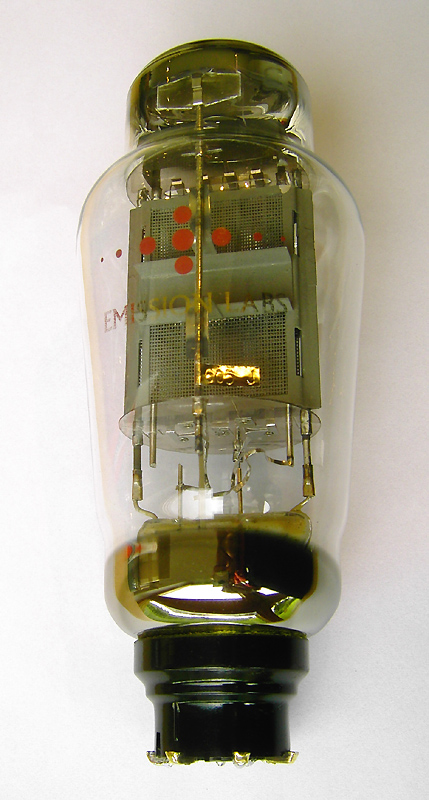
EML AD1/350 Mesh with classic 8-pin socket
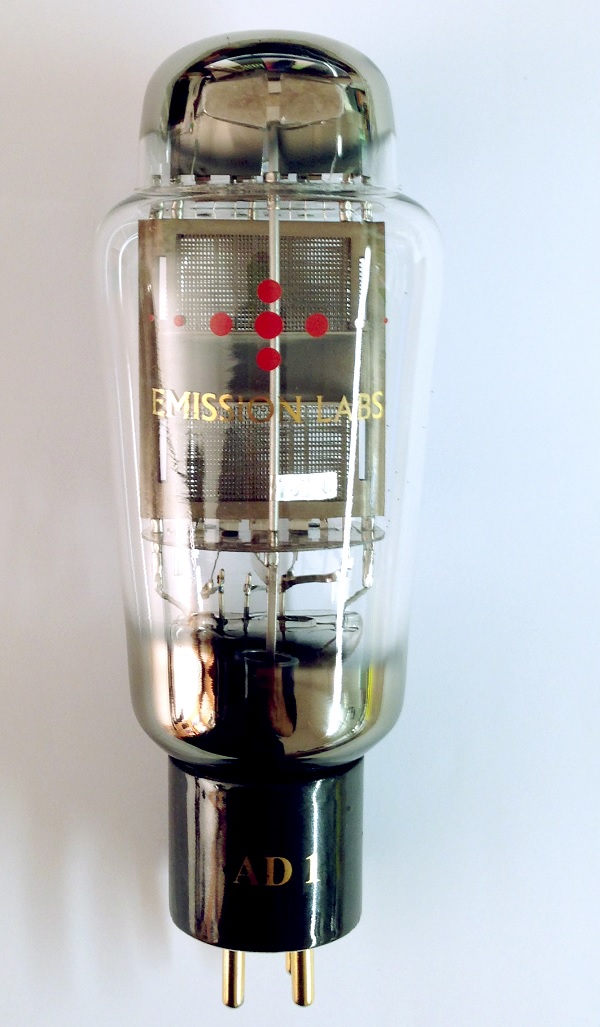
EML AD1/350 Mesh with UX4 socket
Description
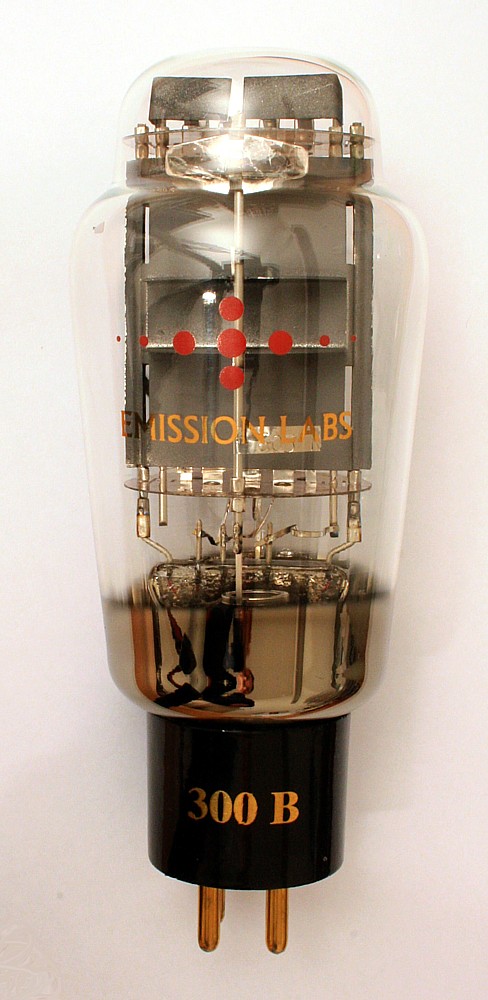 AD1/350 was the Telefunken designation for their higher quality version of AD1, capable to replace any AD1, at classic 250V working point, but also it may be operated up to 350V, in order to bring the tube in a range with better efficiency and additional output power resulting from it, yet without increasing dissipation. This higher working point, with historic versions, it will initially work, but the tubes may develop grid current unexpectedly.
EML AD1/350 however is fully free of grid current at any operation point, also at high use hours as well.
Though it is electrically not identical, any existing 2A3 circuit diagram can be used, provided there is the 4 Volt heater voltage available.
We have a version with the vintage 8pin Side socket, and with the 4Pin UX4 base.
Guarantee program for first owner.
At EML we have the normal guarantee. In addition to that, the first owner can register the tube within 4 weeks after receival, at the Emission Labs® website, to participate in the 5 years guarantee program.
Register here for the 5years guarantee
Features
- Gray Wire Mesh Anodes, mounted on a hard metal frame for best stability.
- Gold plates, Wolfram Grid
- Soft rubber suspended tube base
- Cathode Tapped filament
- Slow Start filaments, for best lifetime
- Anode voltage maximum 350V
- Can be used continuously at maximum Anode dissipation
- Hard metal Construction (See Notes)
- Extra large getters
- Hand blown Glass bulb
- Anti-microphonic Anode- and grid suspension
- These tubes are shipped in a high quality dual box
- Tube printing with real gold (metal), red color is glass burned into the glass
Tube Sockets for AD1
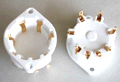 The original P8 'side contact' socket was a Philips development. This socket had an interesting property, it pulls the tube inside the socket by itself. To make this work well, tube base dimensions, socket dimensions and shape of the socket springs has to be exact. We have to mention that new production Chinese sockets are not so ideal, and shape of those can be bad. At EML, to build the AD1, we use Vintage tube bases from the 1930's, of which we have some old stock. For the amplifier chassis, we recommend NOS tubes sockets, as we sell for a low price.
Sound Character of the AD1
The higher heater voltage of 4 Volts, is also the source of another sound. This effect is only so with directly heated tubes. The AD1 sounds less dominant, more silky than 2A3. It can be said that all 4Volts DHT from the 1930's 1940's have very high collector's value, much higher than 2.5 Volts tubes have ever achieved.
Let me quote Rainer zur Linde, who wrote several books in German language about historical tubes. Translated here in English: 'AD1 is the highlight of European DHT triodes, and also marks the end of the period of DHT tubes manufacturing'. Perhaps there is no better way to describe this tube.
Filament Ratings (See note 5) |
|
| Filament Voltage | |
| Electronic heater modules: | Only voltage source |
| Tolerance on filament voltage | |
| Filament Current | |
Maximum Conditions
|
|
| Anode Voltage | |
| Anode Current | |
| Anode Dissipation Fixed Bias (Continiously) | |
| Anode Dissipation Auto bias (Continiously) | |
| Highest possible Grid to ground resistor, Single Ended, Auto Bias. | |
| Highest possible Grid to ground resistor, Single Ended, Fixed Bias. | |
Typical Tube Parameters
|
|
| Anode Impedance (Rp) | |
| Amplification Factor | |
| Transconductance (Gm) | |
Recommended operating points
|
|||
| Anode Voltage (to Cathode) |
250V |
300V |
350V |
| Supply voltage (to Ground) |
295V |
360V |
423V |
| Anode Current | 60mA |
50mA |
43mA |
| Anode Dissipation | 15Watt |
15Watt |
15Watt |
| Cathode Resistor (Rk) | 750R |
1k2 |
1679R |
| Control Grid Voltage | -45Volt |
-60Volt |
-73Volt |
| Load Impedance (Ra) | 2k5 |
4k2 |
6k3 |
| Recommended Lundahl Transformers | LL1623-060mA |
LL1679-70mA |
LL1620-060mA |
| Power Output | 4,5 Watt |
5,3 Watt |
5,8 Watt |
| These operating points are recommended in: 'Elektronenroehren, 2. Band, by H.BARKHAUSEN, 1928. This is one of the finest tube electronics books that I know, and several chapters are dedicated to the wonderful AD1 tube. | |||
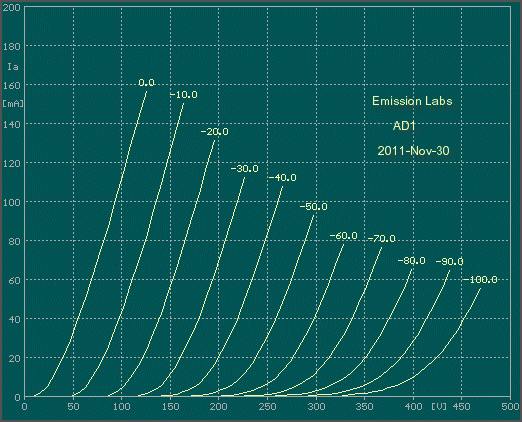
EML AD1-Mesh Anode Curves
Download these curves as PTE file - What is that?
|
||
Primary |
Secondary |
|
Singe Ended. |
Ra= 3000 |
Alt.B = 4Ω Alt.C = 8Ω Alt.D = 16Ω |
Singe Ended LL1664-60mA 13Hz @1.5dB |
Ra= 3000 |
8Ω Only |
Parallel Singe Ended |
Ra= 1600 |
Alt.C = 4Ω Alt.D = 8Ω Alt.E = 16Ω |
Push Pull |
Raa= 6000 |
Alt.B = 4Ω Alt.C = 8Ω Alt.D = 16Ω |
Push Pull |
Raa= |
Alt.B = 4Ω Alt.C = 8Ω Alt.D = 16Ω |
Push Pull (with optional 25% Cathode feedback winding) |
Raa= 6000 |
Alt.B = 4Ω Alt.C = 8Ω Alt.D = 16Ω |
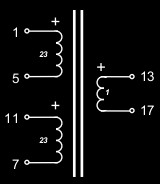
.
Mechanical Data |
|
EML Logo is |
Size including Socket: 65 x 150mm |
|
Size including Socket: 147 x 60 mm Weight of one tube: Pin 1: Heater1 |
| Single Tube weight | 110 Gram |
| Shipment weight for pair in gift box |
600 Gram |


Notes
Note1) Gold Plated grids is a difficult to use technology, which reduces grid current to a minimum. Philips and Tungsram historical AD1 tubes suffer often from grid current and/or gas problems which may occur after the first 500hours of use. To the contrary, EML tubes have superb stability of the tube bias, and grid current much below 1uA.
Note2) Individual Test data, such as: Matching Data, Grid Current, Vacuum, Filament Current, etc., are on the Certificate that comes with each individual Tube. Each tube is numbered, inside the bulb with a metal Tag
Note3) Serial filaments is a technology, found in all later types Emission Labs® tubes. We use a Cathode Tapped filament wire for this. The Cathode Tap is physically located on the mica Anode the bottom of the tube. By this we connect two filament wires are in series, and the connection point is the Cathode Tap. Since this Cathode Tap can not be connected to the outside of the tube, we call it a virtual Cathode Tap, but actually it really exists inside the tube, and ensures a perfect balancing of the emission of each individual filament wire. By this method we reduce tube hum to the lowest possible level.
Note4) Best Heater voltage is precisely 4V on the tube pins. Tube pins is not the same as socket pins, because 1.5A is a high current, and there are two contacts in the path. We recommend appr 0.1 V additional for this on the socket, to compensate for voltage drop across the contacts. So 4.1V on the socket, equals 4V on the tube itself. It is possible to exceed the heater voltage with +5%, with no change to lifetime or functioning. However working below specified heater voltage can impair tube function. If so, initially the tube seems to have no problem with it. However after some 100...500 hours, bias current may begin to reduce. If this took place, the following wil help. With normal anode voltage on the circuit, normal operation, just correct the heater voltage to 4.3V on the socket, and the tube begins to recover after a few minutes. After some hours burn in like this, the tube is good again, and voltage can be reduced to normal, and the tube will be in good condition just like before.