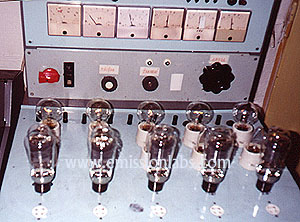
About tube matching with the Amplitrex AT1000

Amplitrex AT1000 Website

We do not sell AT1000 testers. This page is just some help for those who already own one, or think of buying one. The Amplitrex tester can do very high plate dissipation and up to 500V, which no other new made tester can do. It uses quite accurate Volt- and Ampere meters inside. We use three AT1000, and they all give the same test results.

When testing the EML tubes in the factory, there are many steps which are part of the quality control, and also just help to reduce costs. Tubes are already pre-tested when they are evacuated for the first time, while still on the vacuum pump. This is the one and only moment where we can actually read the vacuum on a vacuum meter, on a working tube. Vacuum is carefully monitored, while the tube is operated at more than normal power, and the plates get red glowing hot. It is in this condition we want to see no out gassing at all. Otherwise, the tube has not passed at this point. It hurts sometimes to smash a tube which perhaps is not bad at all, since in real life the getter will probably solve a small problem. Such tubes however are second choice from the beginning, and we are not such a manufacturer.

If the tube passes at this point, it gets sealed and from now on, there is no way to ever measure the vacuum again. Also not electrically though many people think so, and some tube testers suggest it. Now the tube proceeds to getter flashing. Then it is send to the burn in room for some cycles, for the filament to build it's final condition. After that the tube is going for final testing, and when it passes it's a good tube. Now it gets the base attached to it.

After final test comes the matching, and this is the data for the end user, that we write on the tube box outside. Here is where the AT1000 is used. For matching there are a few good ways. What you need for a pair or a quad, is the same bias, and the same gain. (Gain in the amplifier circuit results from a combination of the following parameters: Transconductance (Gm), plate impedance, primary transformer impedance, and transformer load). Gain actually always is the same in the end. For some reasons always some effect is compensated by another, and gain stays more or less the same, as long as the tube has enough emission. More important is Gm as a number that indicates changes with the tube, whatever the reason for the changes. Gm will go down slowly when tubes get older, it is normal, and no need to replace the tubes. To judge the CHANGE in Gm, you need to know the initial Gm, when the tube was new. Not so much the data sheet value. This is why we test Gm at production, and write it on the tube box. It is why we re-test Gm if there is a question about a tube. Pair matching is done based on the Grid voltage.

We have sometimes customers who want to repeat that test. For that reason we decided to offer a method which you can easily repeat, but you do need to use the same tester as we do. At the factory we use for this the Amplitrex AT1000 computer tester, and if you can afford it, we think this is the best tester to buy at the moment. The advantage is, you and we can always see if something has changed to the tubes, since initial test data is collected with the AT1000, and documented on the tube box. So unlike some others, we have no mysteries at EML about how the tubes are tested. Test settings are on the box, and can be verified at any time.

Note, when you want to repeat the matching test, use following steps:


Note 1: You can save new tube data either directly in the tester, using the editor program and the upload software. Alternatively you can save new tube data on your computer, which works much faster. Either as a new entry in the complete tube data table, or as an individual set up file. Making a new Set up file is the easiest way, and the best thing to do when you're new with the AT1000. So just change the main mask with all the settings, the way you need it. When you're done click "Setup, Save" and there you go.

Note2: In case the tube under test was abused, and a bit weak at first, you may see a recovery process. If so, re-start every time the plate current in 20% up. The recovery process is a self repair that relatively new tubes may show. In such cases, the problem was obvious not with the tube, but with the application. Such a tube may self repair on the AT1000 up to 90% of the original Gm value, which is considered a used, good tube then.