
EML1605, EML1605-V4 Data Sheet
Last Update:
Description
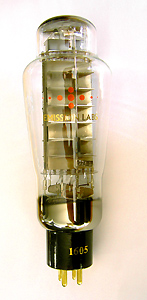 |
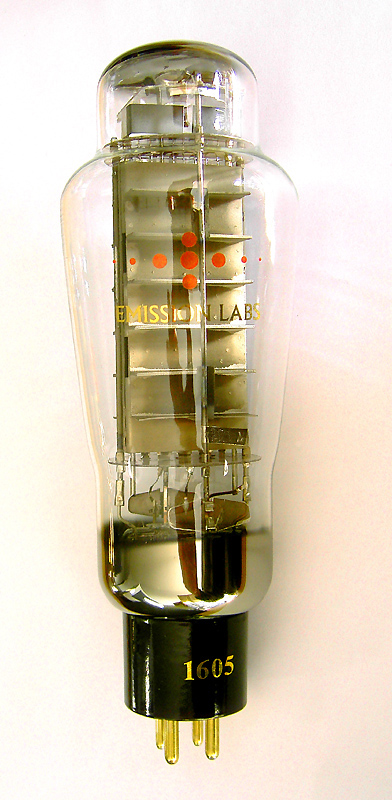
This powerful triode is designed for amplifiers without compromise. This tube is not directly in the family of 300B tubes, but rather related to the famous PX25. |
Guarantee program for first owner.
At EML we have the normal guarantee. In addition to that, the first owner can register the tube within 4 weeks after receival, at the Emission Labs ® website, to participate in the 5 years guarantee program.
Register here for the 5years guarantee
Description
The EML1605 is not directly in the family of 300B tubes, but more related to the famous Marconi PX25. The EML1605 is a medium gain tube, characterized by the more silky sound of PX25.
The 1605 is made for somewhat higher voltage, and it has almost twice the gain of a 300B tube. The PX25 is characterized by a more a silkier sound, if compared to 300B or 520B. The Marconi company had two tube for this, the PX25A which is the low gain tube, almost a 300B, and PX25 which was the medium gain tube.
The higher gain and higher impedance of the 1605 has practical reasons. In general, to get more power out of a tube, the anode dissipation has to be chosen higher. However, simply increase the anode current, is not possible, as this will reduce the grid voltage to a point where you can not apply the necessary grid signal any more. The 1605, for that reason, was designed for somewhat higher anode voltage. In this way, plate dissipation is increased while the anode current does not have to be increased. A huge advantage comes now, with the SE transformer, as it does not have to operate at excessive DC current. This (lower) DC current makes the transformer easier to build, and also the inductance of the transformer can rise. The higher impedance of the 1605 makes the higher inductance is needed anyway, so all things fall into place. In order to increase the power supply efficiency, the bias voltage of the 1605 is lower. So there will be less voltage dropped (wasted...) across the bias resistor. This lower bias voltage of course reduces the maximum signal we can apply, but since the 1605 has more gain, the total input can be lower. This makes the driver stage easier to build. So as you see, a few more things fall into place as well. All in all, the is a very nice working concept.
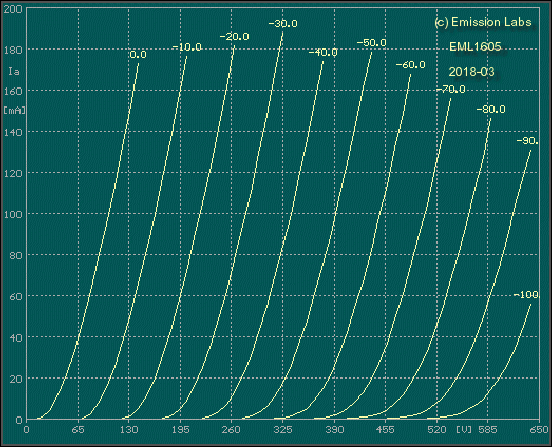
The high filament current of the 1605, stands for excellent emission, which on a glance can be recognized by the good linearity of the tube curves, and on the long term, tube life benefits from this very much also. Basically all properties and data, improves if a tube has higher filament power.
We have two versions for the heater.
 Normal heater (V3-Version), or Cathode Tapped heater (V4-Version).
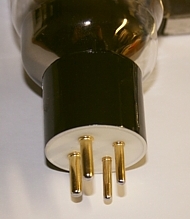
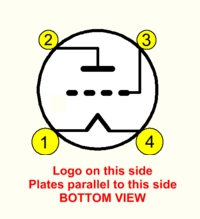
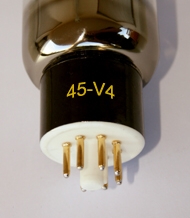
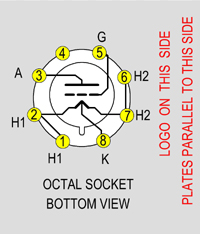
With the Cathode Tapped tubes, we enter a new field of applications. This has not been done before with Audio tubes. When biasing a normal DHT tube, like 300B or any other, there is no cathode to connect something to. The cathode must be artificially constructed, by a resistor network, which is a small compromise. Reason is, inevitably, not just the tube's DC current, but also the complete AC signal current must pass through those resistors, which has some obvious disadvantages. Provided the heater wires are all serialized, we may tap this in the center, and voila: We have our cathode back again. Moreover this behaves like a real cathode. So the V4-tube has an Anode, a Grid, and a Cathode. The centering resistors are no longer needed. For the heater we have connections H1 and H2, and all we need, is a floating 5V connected to it. We took the opportunity, to connect H1 and H2 each with two contacts, to have lower contact resistance. So indeed, we end up with a real, 3-connection triode, and a 5V heater. Now the tube has five wire connections, and for this reason we can not use the 4 Pin UX4 base any more. We have chosen for the Octal base. It must be said, the V4 is a very special tube, which fulfills the needs of Circuit Design purists the best possible way. Depending on how you do it, you can enter new design fields. Or, it is still possible, if you change your mind, connect a V4-tube, the classic way, like any 300B or 520B-V3. In that case, disconnect the Cathode Tap, and connect the remaining 4 wires like any regular Directly Heated tube.
Here is an application note, for how to use the V4 (Cathode Tapped heater) Version.
Sound Character of the 1605 tube
When tubes are made larger and larger, such tubes often sound only good at high power. At low power, the sound becomes sterile, and the triode sound character gets lost. The 1605 is constructed to avoid this problem. It has wide, box-shaped Anodes, same as Marconi PX25, which tube is legendary for it's sweet, silky sound also at low power. This similarity gets also reflected by the tube curves of 1605, showing resemblance to PX25.
All together it can be said the sound of 1605 is in between 300B and PX25, though much higher power levels are possible.
Features
- > Double Mica tube top
- > Gold Grid (Note)
- > Soft rubber suspended tube base
- > Cathode tapped filament
- > Slow Start filaments, for best lifetime
- > 0.5 mm thick Anodes
- > 12 coolers (6 on each side of the Anode)
- > Hard metal Construction (Note)
- > Two side getters, one top getter
- > Hand blown Glass bulb
- > Anti-microphonic Anode- and grid suspension
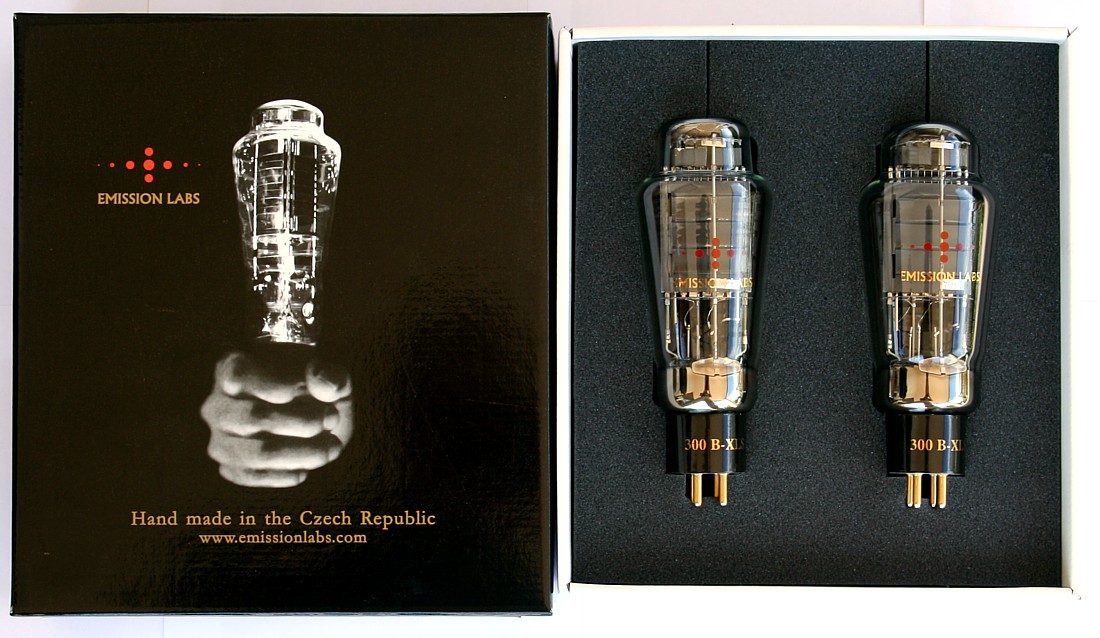
- > These tubes are shipped in a high quality dual box
- > Tube printing with real gold (metal), red color is glass burned into the glass
- > YAMAMOTO tube sockets highly recommended.
- > Gold Plated pins, black ceramic socket, with white bottom.
EML 1605 Filament Ratings (See note 5) |
||
Standard tube EML1605 |
Cathode Tapped EML1605-V4 |
|
| Filament Voltage(AC or DC) | 5.0V |
5.0V with Balanced Heater. ( 2x 2.5V ) |
| Electronic heater modules: | Only voltage source |
Only voltage source |
| Tolerance on filament voltage | 4% |
4% |
| Filament Current | 2,1Amp |
2,1Amp |
EML 1605 Maximum Conditions
|
|
| Anode Voltage | |
| Anode Current | |
| Power Output in Class A | |
| Grid resistor | |
Typical application
|
|
| Anode Voltage | |
| Anode Dissipation | |
| Anode Current | |
| Control Grid Voltage | |
| Anode Impedance (Rp) | 861Ohms |
| Amplification Factor | 7,5 |
| Transconductance (Gm) | 8.8 mA/V |
| Power Output in Class A | |
| Input Signal needed for full output Power | 57Volt AC (RMS) |
| Load Impedance (Ra) | |
| Recommended Transformer(s) | Lundahl LL1623-120mA |
| Grid resistor to ground | |
.
EML 1605 tube curves

Recommended Lundahl transformers |
|||||
Primary |
Secondary |
Auto Bias Cathode resistor |
Anode Current |
Anode Voltage to ground |
|
LL1623-120mA |
3000Ω |
Alt.B = 4Ω Alt.C = 8Ω Alt.D = 16Ω |
800 Ohms |
110mA |
668V |
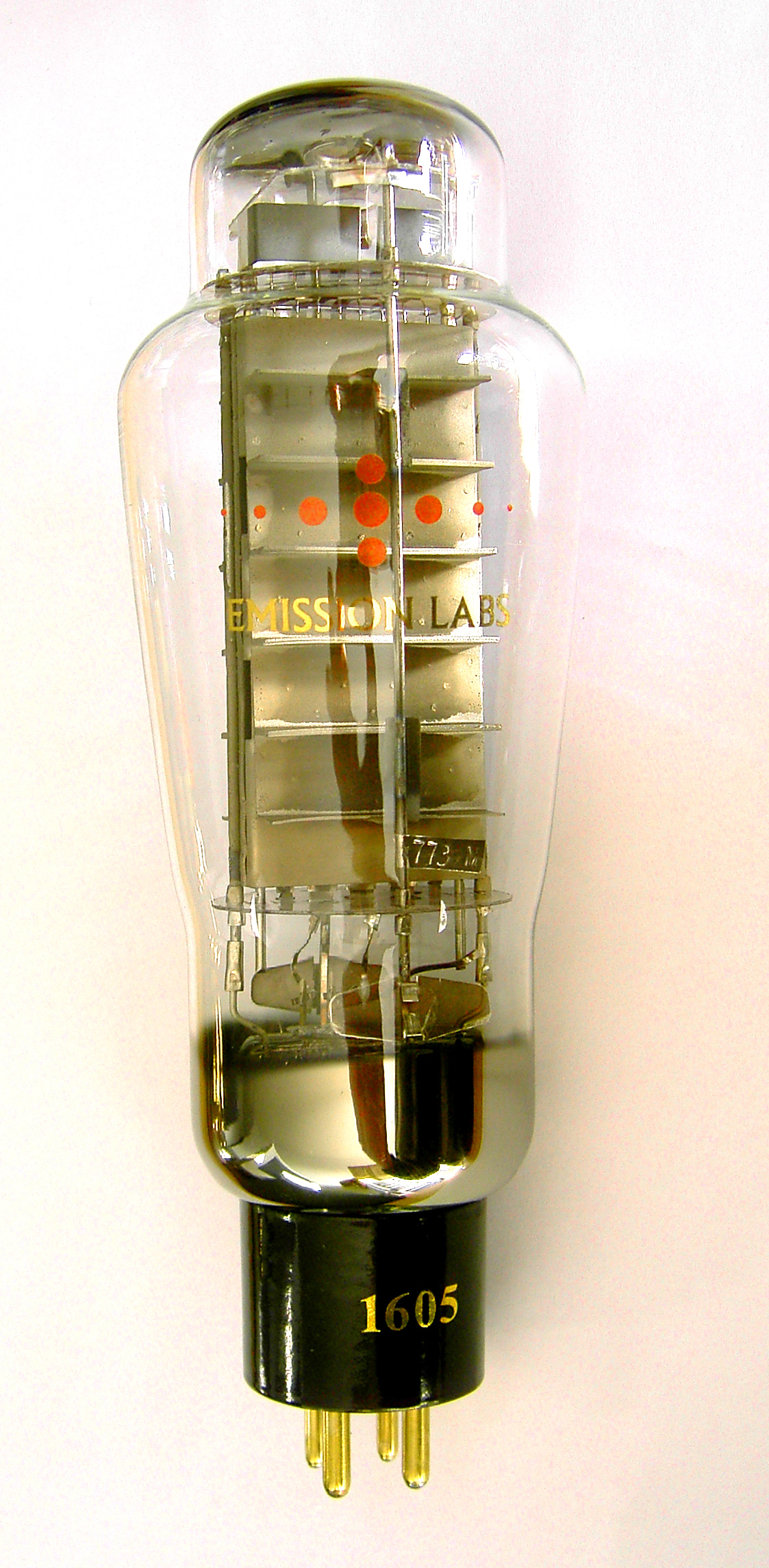
EML1605 Mechanical DataSize including Socket, but excluding pins: 200 x 68 mm |
|
|
|
|
|
Notes
- Hard-metal can be used in electron tubes, though this is more difficult to use, and more costly than classic nickel. It results in a more precise Anode distance, and does not damage in shipment. It ensures reproducible tube parameters, and long term stability. Wolfram grids allow the most precise grid wire distance, because wolfram is an extreme hard metal. Best grid geometry ensures uniformity and linearity of the tube curves.
- Individual Test data, such as: Matching Data, Grid Current, Vacuum, Filament Current, etc., are on the Certificate that is on the outside of the tube box. Each tube is numbered from the inside, with a metal Tag
- Average Plate Characteristics: Made with the Sofia Digital Curve tracer.
- We are recommending the same values as Western Electric in their 1950 Data sheet.
- The Western Electric 1950 Data sheet. says 36 Watt maximum dissipation. Later data sheets say 40 Watt. Though 40 Watt is possible, this is a peak value only, and no normal working point. When you intent to get the 'maximum' out of a 300B, and operate this tube at the limits of safe operation, it is a better idea to use the 300B-XLS in such a case.
- Some of our competitors claims to be the only one with a Center Tapped filament, but this is not true. At EML we build since many years all tubes Cathode Tapped, not just the 300B.
- Do not experiment with lower filament voltage, to expect better lifetime. We already specify filament voltage for the best lifetime.
- Gold Plated grids have a few advantages, such as increased bias stability, some protection against accidental overload, and better linearity of tube curves.
- The curves for the 300B are plotted, with AC heating. This is in accordance with the historical WE data sheet.