Saving the world from Solid State

Frequently Asked Questions (FAQ)
Description
| 1 | What to do in guarantee case?As long as the tubes are on the general guarantee., the company you bought the products from, is the first contact. If the general guarantee is over, it depends if you have registered the tubes for the five years program. With this program, we can see better to which countries our tubes are tubes are sold, and by which dealer. As an incentive for the tube owner, who took this short trouble to register, we offer a 5-years extended guarantee. Any follow up with the 5-years extended guarantee is done by Emission Labs directly. |
| 2 | Can I register tubes for the 5-Years program afterwards, so after legal guarantee has ended?The answer is no. That is because we offer this program as a reward to the first owner, for timely registration, directly after purchase. |
| 3 | Do the tubes need a burn in?Yes they do! Good Burn-in will assure maximum lifetime and develop the final sound. Lifetime of EML tubes is exceptional long, as you can also see from our guarantee conditions. This also means, the burn-in process may take longer as compared to other tubes. Burn in may take a few hundred hours under normal (home) use conditions. Specially when it seems, burn in takes takes to long and nothing happens, the tubes rather need 300 hours than 50 hours. It is better to switch off the amplifier after each use, for best formatting of the cathode. The tubes benefit from the cold periods in between. Some occasional blue glow effects will disappear during burn-in, or may stay. This is not gas, and it is normal. Use different loudness levels from the beginning, and increase the maximum loudness gradually. If tubes were switched off longer than 18 months, is may be necessary to repeat the burn in. Some background: These tubes are burned-in initially, because factory testing can only be done after the tube data has become stabile, and after a tube has developed strong emission. However emission of the cathode is still not homogenous at this moment. After full burn in, emission is build by many small islands, overlapping each other. Though initially, these islands do not fully overlap. This slow development of a homogenous layer, is the final burn in process. The tube should be given time for this, and not stressed into it. This is why we advise to do the burn-in process under normal use conditions. Many short use periods have a better result than few long periods. Switch off the amplifier after each use, and in the beginning not use the tubes longer than 4 hours at one time. Many short use periods have a better result than few long periods. The tubes need the cold periods in between for best formatting. Use different loudness levels from the beginning, and increase the maximum loudness gradually. If tubes with very little use were switched off longer than 18 months, it may be necessary to repeat the burn in. So tubes that were not used for some years, may sound harsh, and simply need a new burn in. Blue glow during burn in: Some blue glow effect on the glass will disappear during burn-in, or may take longer to disappear eventually. What you observe, is a fluorescent effect, and it is normal with new tubes, even so proving the cleanliness of the glass itself. |
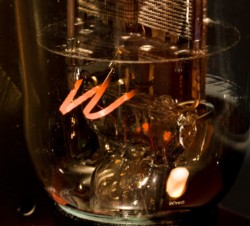
| 4 | BLUE GLOW in the tubesThis is am interesting subject, because the effect is visible. There are a few kinds of blue glow.
|
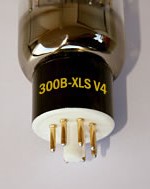
| 5 | Can 300B MESH tubes be used in any 300B amplifier?It depends. Until 2025, we had only one such tube, called 300BM. This tube is to be used at typical 22 Watt dissipation, and maximum 28 Watt. This is somewhat lower as most amplifiers use. So the 300BM you can only use, if you or your technician have a way to reduce the plate dissipation. In 2026, we introduced the 300BM+. This mesh tube can used on any 300B amplifier. However, being a mesh tube, we do not recommend it for head phone applications. There may be some more noise with mesh tubes in general. Not audible with normal speakers, but it may become audible with as high efficiency head phone. By the end of 2026 we plan to introduce the 300B-XLM. This is a mesh version of the very popular 300B-XLS Read the 300B Mesh data sheet for more information about this. |
| 6 | How does the sound of 300B compare to 300B-XLS, or 300BM+ or 300B-XLM?In most data sheets we have now a paragraph called 'Sound Character of this tube'. To compare two tubes, just compare the sections of the corresponding data sheets |
| 7 | Can I use the tubes in horizontal position?If the tube is horizontal, there are two ways for that. One is possible, the other not. Even when the tube is horizontal, in that case the plates must be in the vertical position. So not, with the plates in the horizontal position. Don't knock on the working tubes. This is useless and bad to do in general, and specially with horizontal tubes. (See also the next FAQ) |
| 8 | Are EML tubes microphonic?There is no general answer to this, because no standardized measurement exists. From our side we have done what we could, such reducing mass of the filament suspension systems, and using triple mica in some of the larger tubes. Unexpected for many, the inner system (Anodes, grid, etc) should not be attached to the mica very tight, or a ringing effect will occur. So if you hear some small mechanical noise while shaking a tube, this is not creating microphonics, rather preventing it. Also, the electronic circuit itself plays a major role in the overall microphonics. Good and bad circuits exists. WIth this respect we have seen finest circuit diagrams, designed by amateurs, and really beginners mistakes by companies with world known names. Optical quality and electrical quality do not always go together. Let's say this applies for tubes, and for amplifiers as well. So you can have an amplifier which has a microphonics problem with some tubes or tube brands, whereas the SAME tube, when used in another amplifier has no microphonics problem at all. People try to judge microphonics by tapping on the glass, but the relation between 'tap-sensitive' tubes and microphonics is not very direct. When you tap on the tube, some inner system noise gets audible, such as resonance of the filaments. However, such noise will not appear under normal use conditions. Microphonics in the real sense of the word, means the acoustical sound signal gets in, through the glass, which follows another path, and follows other rules. Better is not to tap on a working tube, because you will stress the filaments. While glowing, the metal is soft and fragile, so they should not be tapped on when hot. To some extent, mesh tubes are less microphonic, since the woven mesh wire by nature is one of the best damping materials, also used in industry for this purpose. This does not apply for the fake mesh tubes that are made in China, these are Solid Plate with holes in it. This has only the optical effect, and nothing else. |
| 9 | Can I tap gently on a working tube?We know people LOVE to do this, no matter what we say. But this is a VERY bad thing to do. This causes hidden damage, giving trouble later. The filaments are red hot glowing, and the coating powder can chip off at a later moment. Also, it causes beginnings of re crystallization of the wire, which at a later point can develops a crack, and then filament will break, apparently for no reason. Yet, it may be caused by the various tapping sessions, which have shortened tube life. Cold filaments are quite resistant against this, but working tubes really suffer from it. Also, it may cause a heater to grid short, which will give am incredible loud crack noise. Hopefully you don't do this with a head phone, but it may also damage the tweeters if that happens. Just for fun, at HiFi shows, we sometimes place some (already defective) tubes at a place where people are unobserved. After 3 days, these tubes are totally hit to death, with broken glass pieces inside. The instinct to hit on the tubes from the outside, it seems like everybody gets satisfaction from doing it. WIth working, new and good tubes however, all we can say is: DON'T do it. |
| 10 | Can I serialize tube filaments?No of course this can not be done. All tubes ever since 100 years, are made either for voltage powered filaments, a for a serial circuit. Very few tubes exist, which are specified for both. A current specified tube is made such, that if you inject exactly this current into the filament, the temperature will be right. These have some tolerance on the voltage which result from this, but this plays not role, as long as the CURRENT is correct. Moreover, current specified tubes have some constructional details which makes the cold start current no damage some tubes in the chain. Yet in the end, the voltage across such tubes is not controlled very exactly in production, because that is not important during use. The opposite is true for voltage specified tubes. The current of two random tubes from production can easily vary 10%, due to natural tolerance of coating thickness, and other factors. However as long as the tubes are supplied with 5V, there is no wire temperature change because of this. A problem comes however, when two 5V tubes, with for instance 5% different heater current, are serialized. It is obvious one tube is above 5V and the other is below 5V. This by itself gives for instance already 5% voltage difference. So serializing two 5V tubes, and connect it to a 10V source, may as well result in one tube at 4,8V and the other at 5.2V. So far this may seem not much, but it is 4% off in tolerance. Leaving only 1% for mains voltage tolerance. Which fir sure is not enough. Besides, it cause difference aging of the tubes, each not ideal, and each with other effects. (Over heating and under heating, both is not a good thing to do). Also read the next FAQ about this. |
| 11 | Can I use an electronic current source for the filament?Unfortunately, at EML we have to deal with a lot of stupidities, caused by this. For this reason, we exclude all electronic current sources from the tube guarantee. There is strong a tendency, to do things the "alternative" way, mostly by beginners, who seem to dislike classical concepts. However good, and proven concepts, do not have their reputation for no reason. In tube factories and design labs, during the last 100 years, the number of people who have been trying new, clever and interesting things, must be in the order of millions. The world is large, and when I take 100 people per day trying 'new' things, I find over 100 years 36.500.0000 attempts. Those attempts were sometimes done by just fools, and sometimes by highly intelligent persons. People, like for instance Julius Futterman, who spend his whole life on improving just one circuit. You can really say, any new idea, whatever it is, has been tried out by 1000's of others, and if the idea was good, it would be already known technology for decades. It is not inspiring to say, but there is really nothing new, waiting for you to be discovered on a Sunday morning at your tube bench. It is near to impossible to find something new with tube schematics. So when you have this fantastic clever idea, which all those fools from 100 years of tube technology have not found out yet, it should ring a bell. There is no 'better sound' or longer life, if you use a heater current source, simply for the above reasons. Even so, special CURRENT SOURCE ONLY tubes have been made ever since. It's all those P-Series of tubes, or 26 Volt versions of 6L6, which they throw at you at Ebay, and nobody wants to have them. If these would sound soooo much better, somebody would have found out 75years ago already. Also there are fake theories produced by some vendors of current source devices, just to make you buy their stuff. Our advise is, use a plain 5V heater IC. Do not use 'low drop' versions. Standard versions cost 30 cents only, and they work great. Choose the limiting current not more than 1A higher as the tube, and you have the ideal soft start device. At cold start, these go automatically in current control mode, and when the 5V is reached, they go into voltage control mode. |
| 12 | Can I have 10% tolerance on the filament voltage?There is general misconception, if a parameter has no tolerance specified, one can take 10%. If you have too high filament voltage, this will shorten the tube lifetime. Reason is a very delicate balance, where the filament active layer is evaporating on the one hand, and regenerated from the inside at the same time. This balance is indeed very delicate, and it works best at the correct voltage. As a rule of thumb, lifetime is reduced 3%, for each percent the filament voltage is too high. If we take the 2A3 tube as example, it is made for 2.5 Volts. At 2.8 Volts, you are at +12%. Then 12x 3% = 36%. So lifetime is reduced by appr 1/3. This is so for all tubes, also NOS or Chinese. If you are above +15% another failure mechanism occurs, which is re-crystallization of the filament, much faster than normal. The wire will get brittle, and can no longer withstand the spring tension. Eventually this will lead to filament breakage. Damage by too HIGH filament voltage is permanent. Damage by too LOW filament voltage can often be undone, by simply use the tube at the normal voltage. If the problem was only moderate, it will self repair, provided the tubes are new. |
| 13 | About tube filament hum.Directly heated tubes have some transfer of the AC signal on the heater, to the output signal. If the heater is used 'balanced' which is the only right way actually, the AC signal is very much attenuated, and on the tube output is almost nothing left of it. If the heater is used 'unbalanced', the AC signal will be even amplified by half of the tube gain. So any unbalanced connection is typically when heater is connected with one end to ground, and the other end to +5V. This is no good way, and it will give higher requirements to the +5V, including low capacitive path via the mains transformer. Sometimes you will not be able to achieve a hum free amplifier with an unbalanced heater supply. Much better is also use a balanced heating system also for DC. This give so much hum rejection, even unstabilized DC heating can work hum free. Link to Application Note 06 about the above item
|
| 14 | The rectifier tube has some strange glowing parts inside
These are current dependant resistors, to deal better with heater voltage variations. |
| 15 | I use an AVO Mk4 Tube tester, but the test results of the tubes are not good. Are the tubes defective?The AVO Mk2, Mk3, Mk4 are very nice for small tubes like 12AT7 etc, but not suited for triodes with low Anode impedance and high Anode current. AVO admits this when you look in their data tables for the 6080 tube. Also you will not find the 300B in most of their data books. That should tell enough. You can work around this, when you have an unused pair of new EML tubes. The factory test values of our tubes are very accurate and guaranteed to reproduce within 5% on any good tester. With the AVO you need to set the Anode voltage as on the EML tube box, and initially use -100V grid. Then change the Grid Voltage until you have the Anode current as indicated on the EML tube box. With this Control Grid Voltage you should measure the transconductance. The value should be close, to what you see on the EML box now. Leave the tester as is, and plug in the other EML tube. If both tubes show the correct transconductance this way, they are ok and your AVO also. Any differences are due to the AVO measuring with AC voltages instead of DC, and also many AVO need a new calibration. |
| 16 | I use the Amplitrex AT1000, but Emission is below 100%. Are the tubes defective?This is a long explanation, but interesting for users of AT1000. The hardware of the Amplitrex AT1000 is as good as the software is bad. The hardware is very hard to damage, but the software is terrible. The most common mistake is, the tubes are tested at FIXED Bias. Which is wrong. The right way to test tubes, also EML, is in AUTO BIAS. If using computer testing, select AUTO BIAS, and use fixed bias for whatever you like but not for testing tubes. If you use the AT1000 without computer, hold the ENTER Key down while turning the device on. By letting the key go, and press it again you can now skip to the selection Auto Bias, and set the AT1000 for AUTO BIAS. One of the many bugs is, this tester gets send with FIXED BIAS in the preset. So people do not know, and do not understand why, as well as the AT1000 software designer did not know, , and everybody runs into the same difficulties. Set the AT1000 for AUTO BIAS, and you will see many tubes which you though were not good, suddenly test as they should. Also it should ring a bell with you when AT1000 tests sometime a tube with 140% emission. That is fully impossible, it is like a glass of water filled at 140%. |
| 17 | The tube makes a gentle, mechanical ticking noise during warm up. Is this an issue?Not all tubes do this, but it may happen one tube of a pair makes such a noise. This is not a defect, or a quality issue. Due to microphonic effect, it may be gently heard from the speakers as well. As soon as the tube becomes warm, the noise stops. The cause for this is as follows: The filament while warming up, gets appr 0.5mm longer. To keep it stretched, there is this spring in the top. However, during this move of 0.5mm, the filament slides over the mica edge. The mica has not a smooth surface, and while the filament slides over the edge, appr 0.5mm, this may take place in many very small steps. While the filament acts as a string, this is mechanically audible from the tube itself. As soon as the heater is in thermal balance, after 1...2 minutes, the movement and it's noise will stop. This noise sometimes worries the owner, fearing something is loose inside. However it is normal. It was even mentioned in some historic tube data sheets as well. |